Day 2Friday, September 11, 2026Utah Beach & the Cotentin, Normandy, France
Utah Beach and the Airborne Sector
1944
In the dark before dawn on 6 June 1944, some 13,000 American paratroopers dropped behind Utah Beach. Most landed nowhere near where they were meant to. The 4th Infantry Division came ashore two thousand yards off target — and it was the best thing that happened all day.
2026
The first full day, and the one that goes where Easy Company started. Utah Beach itself, the Sherman and the B-26 on the sand, and the ground inland where the airborne divisions came down.
The first proper day of the tour, and it goes straight to the sector where Easy Company fought its first action.
Utah
Utah was the westernmost of the five beaches, and the landing there went wrong in the only useful direction.
Strong currents and a lost control vessel put the first wave about two thousand yards south of the planned sector. Brigadier General Theodore Roosevelt Jr. — fifty-six years old, walking with a stick, the only general to land with the first wave — worked out where they actually were and made the call: We’ll start the war from right here. The unintended beach turned out to be more lightly defended than the correct one. The 4th Infantry Division came ashore for around 200 casualties, against roughly ten times that at Omaha.
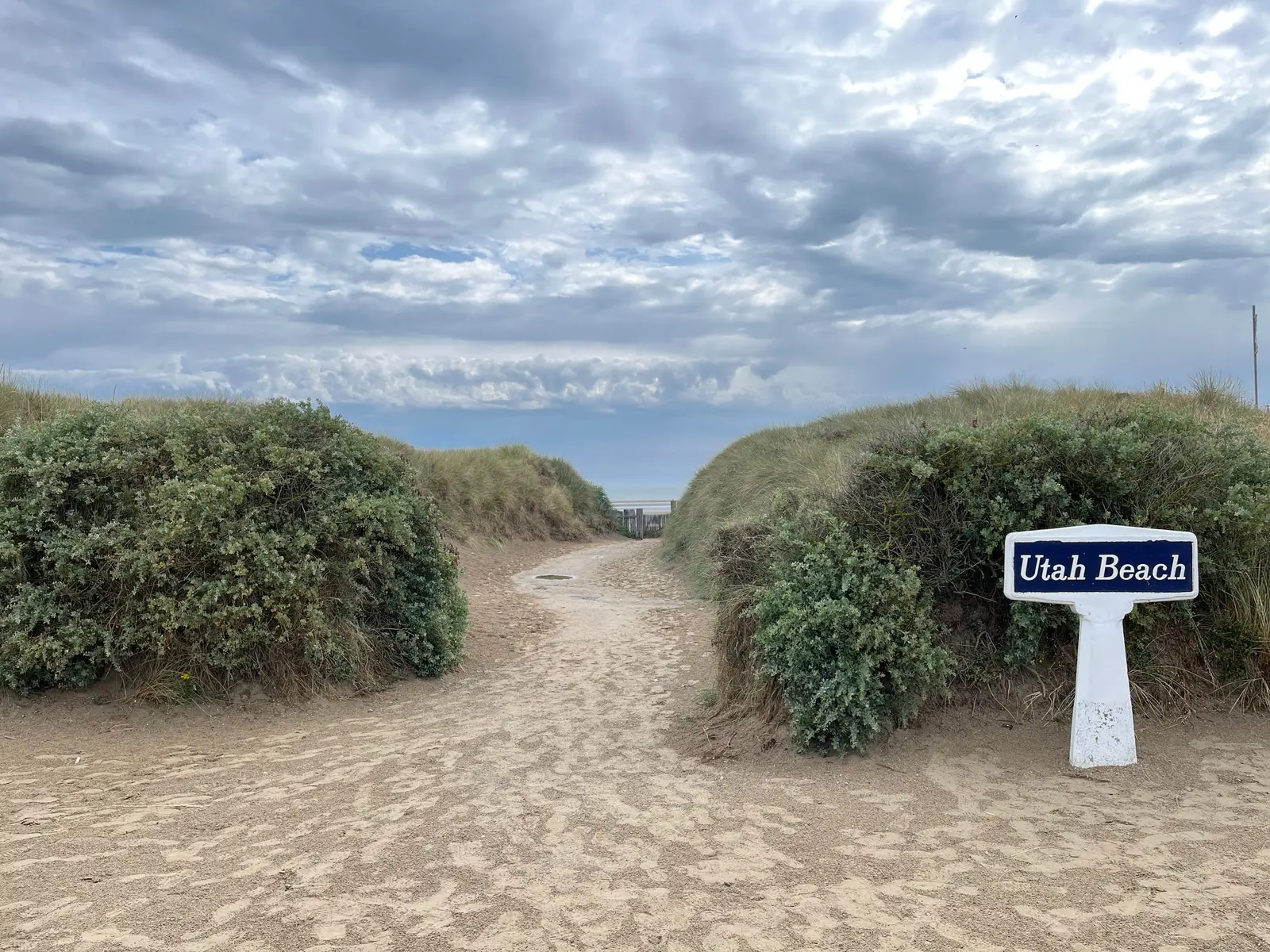
Today it is a wide, flat, quiet expanse with a museum built into the dune line, a Sherman parked on the sand and a B-26 Marauder in the hall. There is a path from the museum through the dune grass to the water that takes about two minutes to walk.
The airborne ground inland
What makes Utah matter to this particular story is not the beach — it is the four raised causeways leading inland off it, and what happened at the far end of them in the dark.
The airborne drop was scattered across the Cotentin. Aircraft came in through cloud and flak, sticks went out miles from their drop zones, and men came down in flooded fields where some drowned under the weight of their equipment. By dawn the divisions were in pieces, and the fighting was being done by whatever groups of men had found each other in the dark.
Brécourt Manor is the one everybody comes for. At about 08:30 on 6 June, Lieutenant Richard Winters was given a report of a German battery firing onto Causeway Exit 2 — one of four places where the entire beachhead could have been bottled up. He had roughly thirteen men against four 105mm howitzers, dug in, connected by trenches and defended by perhaps fifty. He did not attack frontally: he put down a base of fire, moved a small assault element along the German trench system, and took the guns one at a time. All four were destroyed. Four of his men were killed. The action is taught at West Point.
The field is private property and the owners are not welcoming, so the tour stops at the fence. From there it is a couple of hundred metres of ordinary grass, and the whole difficulty is holding in your head that this is the place.
Angoville-au-Plain is a hamlet with a twelfth-century church that sat directly between the two sides on the morning of 6 June. Two medics from the 501st, Robert Wright and Kenneth Moore, both around twenty, treated roughly eighty men in it over three days while the village changed hands twice. They took German wounded on the same terms as American ones, provided weapons were left outside. The pews still carry the bloodstains and have deliberately never been cleaned.
What I expect to be hard
Everything here is small. A field, a hamlet, a two-minute walk to the water. Nothing about the scale of these places matches the scale of what happened in them, and from everything I have read, that mismatch is the thing that gets people — not the cemeteries.
Photographs · 9
Photographed on an earlier tour of this route, July 2023 — not on the September 2026 trip.
Utah Beach
The path from the museum down to the shoreline. Two minutes’ walk, over ground the 4th Infantry Division crossed under fire.
Utah Beach
Beach obstacles recovered from Utah and put back on the sand. Rommel had roughly six million mines and half a million of these laid along the Atlantic Wall, and still thought it was not enough.
Utah Beach
The US Navy memorial on the dune line. It is easy to spend a whole day in Normandy thinking only about the men who went inland.
Brécourt Manor, Le Grand-Chemin
Brécourt Manor. The assault went in beyond the treeline in the middle of the frame. The farm is private property and not friendly to visitors — this fence is as close as anyone gets.
Sainte-Marie-du-Mont
The Richard Winters Leadership Monument, dedicated in 2012 to all junior officers who led from the front on D-Day. Winters insisted on that wording.
Sainte-Marie-du-Mont
Utah Beach is off to the east, past the far hedgerow. The guns at Brécourt were firing across this ground onto Causeway Exit 2.
near Sainte-Marie-du-Mont
Some very familiar names on an ordinary road sign. It takes a moment to adjust to these being places people actually commute through.
Angoville-au-Plain
The church at Angoville-au-Plain, now dedicated to the 101st Airborne. Two medics held it for three days while the village changed hands around them.
Angoville-au-Plain
One of two modern windows in the church, installed in memory of the airborne medics who used it as a clinic in the days after D-Day.
Where this was
This map repeats information already available as text. Every stop is listed in order on the timeline and in the journal index.
- Utah Beach & museum
- Sainte-Marie-du-Mont
- Brécourt Manor
- Angoville-au-Plain